

One of the most common questions I hear from new business owners is:
“When should I build a website?”
My answer is usually the same:
When you can comfortably afford it and when it serves a clear purpose in your business.
That might not be the answer you expected.
Many entrepreneurs assume a website is one of the first things they need when starting a business. It feels professional. It makes the business feel real. Friends and family ask for it. Online experts tell you that every serious business should have one.
The problem is that a website is often one of the first big expenses a new business takes on, and one of the slowest investments to generate a return.
That doesn’t mean websites are bad. I think every established business should have one. The question is whether your business needs one right now.
Why Most New Business Owners Want a Website
When you decide to start a business, it’s natural to look at successful companies and notice that they all have websites.
You begin imagining your own website: a beautiful homepage, professional photos, a contact form, maybe even an online shop. It feels like the next logical step.
The challenge is that many entrepreneurs confuse having a website with having a marketing strategy.
A website can support your marketing, but it is not your marketing.
A website can help customers find information, but it does not automatically bring customers to you.
Before investing in a website, it is worth asking yourself a simple question:
What problem am I trying to solve?
If the problem is that you need more customers, a website may not be the answer.
If the problem is that people don’t understand your offer, a website may not be the answer.
If the problem is that you still aren’t completely sure who your ideal customer is, a website definitely won’t solve it.
The real work of marketing happens long before a website is built.
A Website Does Not Automatically Bring Customers
One of the biggest misconceptions about websites is that people believe the process works like this:
Build website → Get found online → Make sales.
In reality, it often looks more like this:
Build website → Wait.
And wait.
And wait some more.
The internet is full of websites. Every day, thousands of new websites are launched. Simply existing online does not mean people will find you.
Think of it this way. If you opened a beautiful shop in the middle of a forest, would customers magically appear?
Of course not.
People need to know the shop exists. They need directions to find it. They need a reason to visit.
A website works the same way.
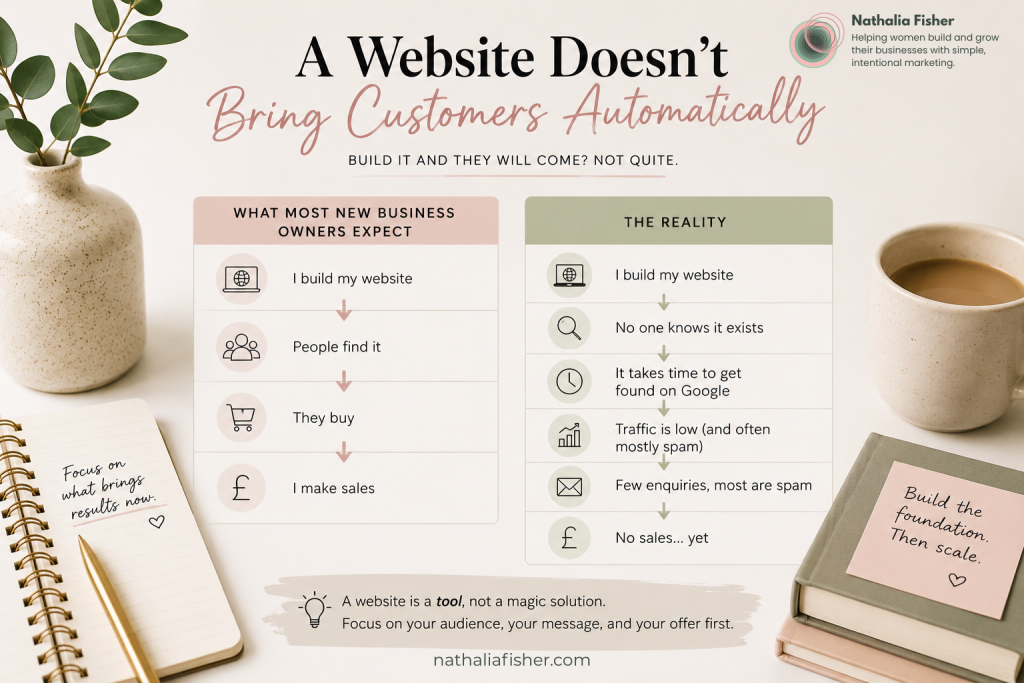
Google takes time to trust a new website. Search engine optimisation (SEO) takes time to work. Building authority takes time. Creating content takes time.
Many business owners are surprised when they launch their website and discover that almost nobody visits it.
In the beginning, some of the traffic you do receive may not even be genuine potential customers. Many new website owners quickly discover that a large percentage of their enquiries are spam messages, automated bots, or people trying to sell them SEO services.
Meanwhile, they are paying monthly fees and wondering when the customers are going to arrive.
The Hidden Cost of a Website
Another reason I encourage new business owners to think carefully before investing in a website is that the true cost is often much higher than expected.
Most people look at the monthly subscription fee and think that is the total investment.
In reality, a website usually comes with several ongoing costs.
There is the website platform itself. Then there is the domain name. If you want e-commerce functionality, the costs usually increase. You may need additional features, payment processing tools, premium apps, or plugins.
Many business owners also hire a designer because creating a professional website can be time-consuming and technically challenging.
Even a relatively simple website can quickly become a significant investment. E-commerce websites are often more expensive because they require product pages, payment systems, customer notifications, and additional functionality.
Then there is your time.
Time spent learning the platform.
Time spent uploading products.
Time spent writing content.
Time spent fixing issues.
Time spent maintaining everything after launch.
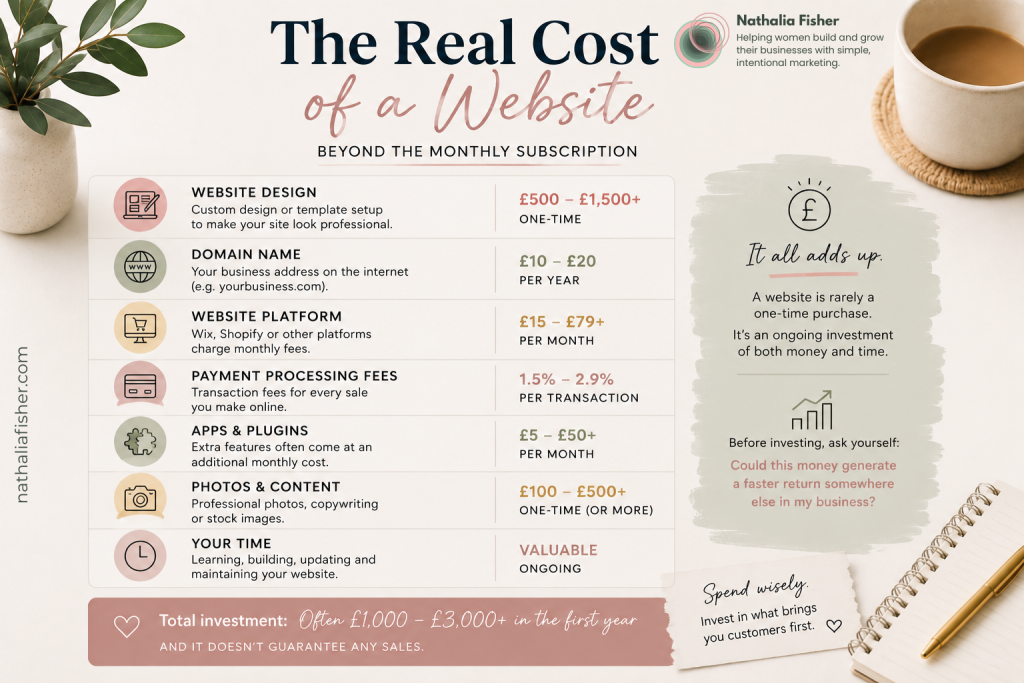
A website is rarely a one-time expense. It becomes an ongoing commitment of both money and time.
Before making that commitment, it is worth asking whether that money could generate a faster return elsewhere in your business.
So How Can You Sell Online Without a Website?
This is usually the next question.
If I don’t have a website, how do I sell?
The good news is that customers care far less about websites than most business owners think.
Customers care about solving their problem.
They don’t wake up in the morning thinking, “I hope I can buy this through a website.”
They simply want an easy way to purchase.
Many businesses make their first sales through Instagram, Facebook, WhatsApp, email, Etsy, local marketplaces, or direct messages.
A cake maker can take orders through Instagram.
A handmade jewellery business can sell through Etsy.
A consultant can book clients through email and video calls.
A fitness coach can sell programmes through social media.
The sales process does not have to begin with a website.
In fact, many successful businesses generate consistent revenue long before they ever launch one.
Go Where Your Customers Already Are
One of the biggest lessons in marketing is that you should not expect customers to come looking for you in the beginning.
You need to go where they already are.
This is why understanding your niche is so important.
If you haven’t read my previous article about finding your niche, I highly recommend starting there.
When you know who your audience is, you start to understand where they spend their time, what questions they ask, and what kind of content they engage with.
You can join conversations in Facebook groups.
You can connect with people on Instagram.
You can attend networking events.
You can participate in local communities.
You can build relationships directly.
For a new business owner, this active approach is often much more effective than waiting for visitors to find a brand-new website.
What Happens After Launch?
This is another part that often gets overlooked.
Many entrepreneurs treat launching a website as the finish line.
In reality, it is usually the starting line.
Once the website goes live, you still need people to visit it.
You still need content.
You still need visibility.
You still need trust.
You still need a way to turn visitors into customers.
The website itself does not do this automatically.
Without a plan to attract people to your website, it can quickly become an expensive online brochure that very few people ever see.
What Should You Invest In First?
If your budget is limited, there are usually better places to invest before a website.
Learning about your niche.
Understanding your customers.
Improving your offer.
Creating better product photos.
Building an email list.
Developing your messaging.
Learning how to communicate the value of what you sell.
These activities often generate results much faster because they directly improve your ability to attract and convert customers.
In fact, these are the exact foundations I focus on inside From Zero to Strategy. Before worrying about websites, ads, or complicated marketing systems, we start by understanding the audience, the offer, and the message.
Because when those pieces are clear, every marketing decision becomes easier.
When Is It Time to Build a Website?
Eventually, there will come a point when a website makes perfect sense.
You already have customers.
Your business is generating consistent income.
You understand your audience.
You know what information people are looking for.
You can comfortably afford the investment.
At that stage, the website becomes a tool that supports growth rather than something you hope will create growth.
You know exactly what you need it to do.
And because you have already built the foundations, it becomes a much stronger asset for your business.
Final Thought
I am not against websites.
In fact, I think every established business should have one.
The question is not whether you need a website.
The question is whether your business is ready for one.
If you’re still figuring out your niche, refining your offer, and learning how to consistently attract customers, your time and money are often better spent on those foundations first.
The website can come later.
And when it does, you’ll know exactly why you’re building it and what role it needs to play in your business.