
Lately, I’ve been thinking a lot about how obsessed we are with doing everything quickly.
It feels like wherever you look, someone is telling you how they built a six-figure business in a year, doubled their sales in a few months, or grew thousands of followers almost overnight. We hear about startups raising huge investments, businesses scaling quickly and entrepreneurs who seem to have everything figured out.
When you see this all the time, it’s very easy to start thinking that you’re behind.
I know I do.
Over the last year, I’ve been working on my new website and my course. It has been a much slower process than I expected, mostly because life has been full. I had my daughter nearly a year ago, I still have my consultancy work, our homestead keeps us busy, and of course, there is family life in between all of that.
There have been plenty of days when I’ve thought, “I really should be further ahead by now.” Maybe if I worked a little faster, had more hours in the day, or stopped overthinking things and just got on with it, I would have finished months ago.
But then I stop and ask myself another question.
Would going faster actually get me there any sooner?
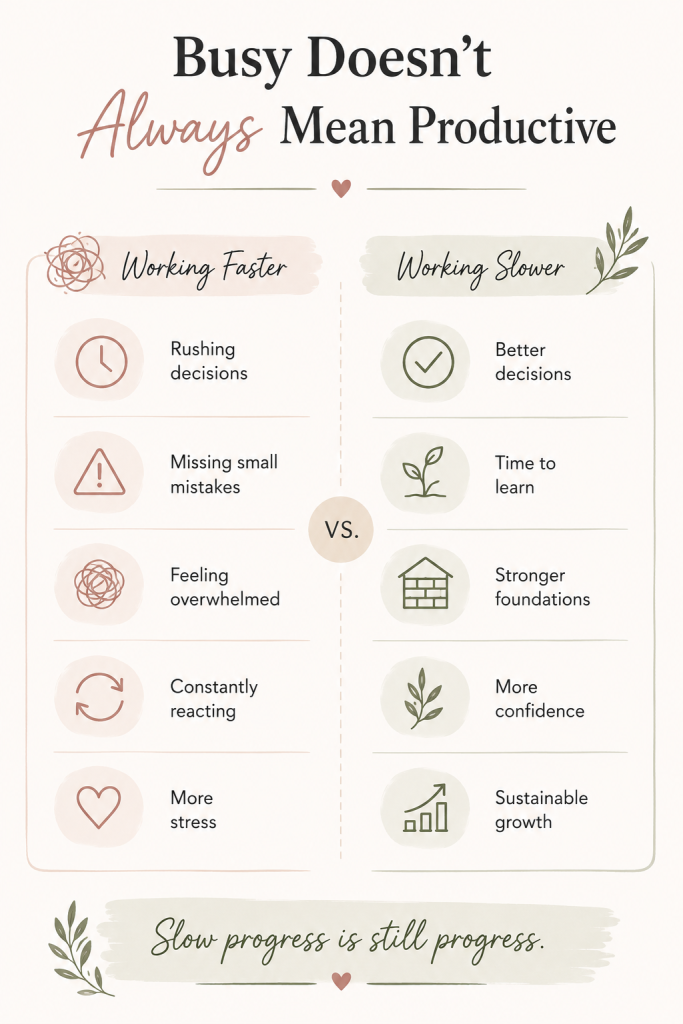
The more I think about it, the more I realise that going faster doesn’t necessarily mean making more progress. Sometimes it just means making more mistakes, feeling more stressed and having to go back and fix things later.
I’ve realised that this pressure to move quickly isn’t really coming from my business. It’s coming from the world around me.
We live in a culture that celebrates fast results, but building a business isn’t something you learn overnight. At least it wasn’t for me.
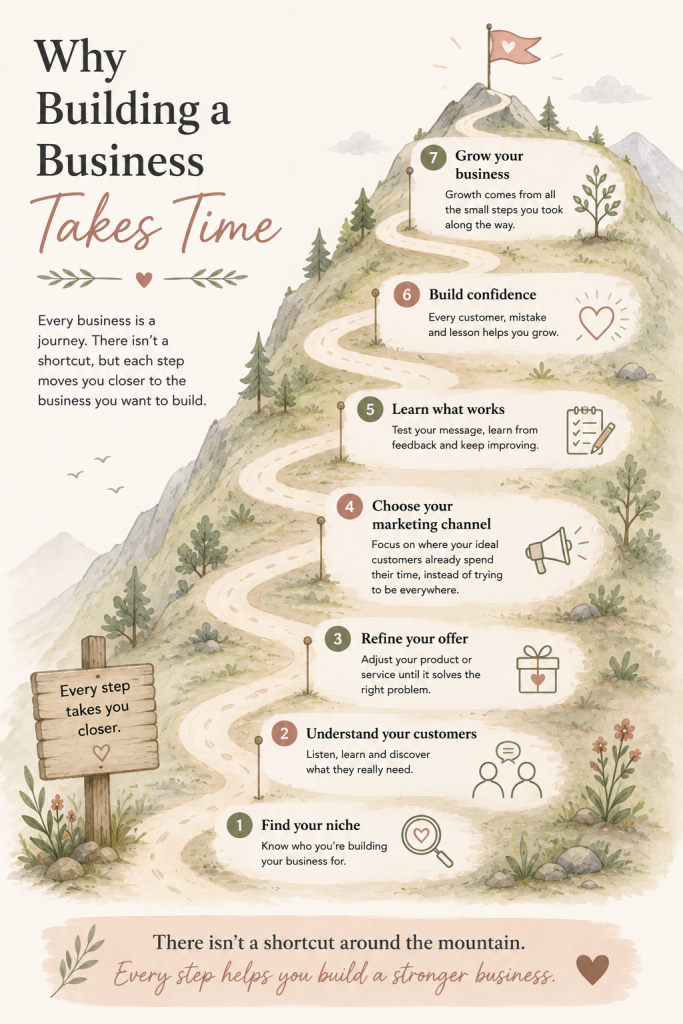
When I started my business, I thought my biggest challenge would be finding customers. I didn’t realise that running a business meant learning a little bit of everything.
One day, you’re trying to understand marketing. Next, you’re learning about pricing. Then bookkeeping. Then writing emails. Then trying to figure out why your website isn’t doing what it’s supposed to do.
Some days you feel like you’ve achieved loads, and then you realise you’ve spent the whole day learning something that no one will ever see.
That’s the funny thing about building a business. A lot of the work happens behind the scenes.
The customer only sees the finished product. They don’t see the hours you spent researching, making mistakes, changing your mind, or starting something again because you’ve realised there was a better way to do it.
I think that’s why so many of us feel like we’re moving slowly. We compare our behind-the-scenes to somebody else’s highlight reel.
We see the launch, but not the months of preparation. We see the successful business, but not the years it took to build. We see the finish line, but not everything that happened before they got there.
The truth is, learning takes time, and I actually think that’s a good thing.
When you’re learning slowly, you’re also giving yourself time to notice things.
I’ve realised this so many times while building my own business. Whenever I start feeling impatient, I also start rushing. I stop paying attention to the little details because all I can think about is getting to the next step, and that’s usually when mistakes happen.
Most business mistakes don’t start as big problems. They’re usually small. Maybe your message isn’t quite clear, your offer isn’t solving the problem you thought it was, you’re spending time on marketing that isn’t bringing any results, or you’re trying to be on every social media platform because everyone says you should.
When you’re moving at a pace that gives you time to look around, you notice these things much sooner. You can change direction before you’ve invested months going the wrong way.
When you’re rushing, you often don’t notice until you’ve already spent a lot of time, money or energy.
I suppose it’s a little bit like driving. If you’re driving slowly and there’s something in the road ahead, you have plenty of time to react, but if you’re driving fast, you don’t have nearly as much time.
Business feels very similar to me. The faster I try to move, the less clearly I seem to think.
And I’ve also realised something else.
Going faster doesn’t necessarily mean making more money.
I used to think that if I worked longer hours, wrote more blog posts, created more content and kept myself busy every spare minute, surely the results would come faster, but that hasn’t really been my experience.
What usually happens is that I become tired, and when I’m tired, I make poorer decisions, I stop enjoying the work, I start comparing myself to everyone else, and before long, I’m wondering why I’m doing any of it in the first place.
Slowing down has actually helped me make better decisions, think more clearly about what my business needs instead of what everyone else is doing, and focus on doing fewer things, but doing them properly.
I know that probably isn’t the most exciting advice you’ll read online, as there are plenty of people promising shortcuts and quick wins. But I don’t think building a sustainable business has many shortcuts, especially if you’re building it around your life instead of the other way around.
A few years ago, a friend of mine completed a 100km ultramarathon. She told me about another participant she met during the race, a lady in her seventies. They were both completing exactly the same course. The difference was that my friend ran almost the whole race, only stopping to eat and use the toilet. The older lady walked the entire 100 kilometres.
When my friend first saw her, she assumed she would finish long after everyone else. Instead, she crossed the finish line in thirteen hours. My friend finished in sixteen.
I think about that story surprisingly often, especially on the days when I feel like my own business is taking longer than I hoped.
It reminds me that moving quickly and making progress aren’t always the same thing.
Sometimes the person who keeps a steady pace gets there first. Not because they’re faster, but because they’re consistent.
I think that’s a lesson many of us need to hear, especially as small business owners.
Most of us aren’t building businesses with huge investments or big teams of people helping us. Many of us are building them around jobs, children, families and all the other responsibilities that life brings.
For a long time, I saw that as something that was holding me back. Now I see it differently.
Building my business slowly has forced me to be more intentional. I don’t have time to do everything, so I have to choose what matters most. I don’t have unlimited money, so I have to think carefully before investing in something. And especially, I don’t have endless hours in the day, so I’ve learned that being busy isn’t the same as being productive.
Maybe that’s why I’ve become such a believer in building strong foundations first. Finding your niche before spending money on ads. Understanding your customers before building a website. Taking the time to learn before trying to grow as quickly as possible.
Looking back, I don’t think going slowly has held my business back. If anything, it’s helped me build something that feels much more like me.
So if you’ve been feeling like you’re behind, I hope this reminds you that you’re probably doing better than you think.
Business isn’t really about who gets there first. It’s about building something that still works for you in five or ten years.
There will always be someone growing faster than you. There will always be someone launching more products, posting more content or making more noise online. But you don’t have to build your business the same way. You can build it at a pace that works for your life.
And whenever I start feeling frustrated that things aren’t happening quickly enough, I think about that lady walking 100 kilometres.
She wasn’t trying to keep up with everyone else. She just kept putting one foot in front of the other.
I think building a business is a lot like that.
You don’t have to sprint. You just have to keep going.